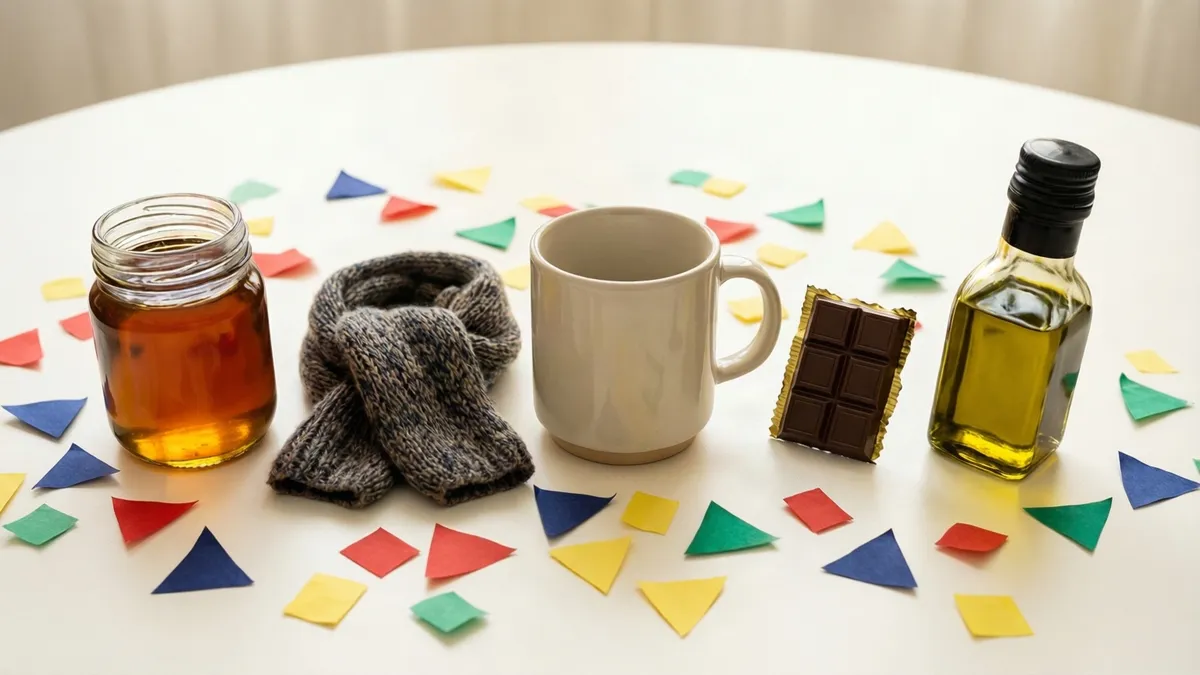
In short: The best white elephant gifts are the ones whose quality you can confirm before you buy. This page is written for the $25 cap most exchanges set, where twenty candidates look identical in a photograph. What separates them is a fact printed on the package or stated in the listing. Every lane below is picked for one such fact.
We write buying guides, not lab reviews: nothing on this page has been tested by us, and no steal count here is a measurement. Prices, availability and ratings change constantly — whatever Amazon shows when you click is the authoritative figure.
Search the term and you get a wall of thumbnails. Same pale wood table, same lighting, same money, and none of it is evidence of anything.
The two jobs, and the layer underneath
Every idea here is judged on the two-jobs test. This page adds the layer underneath it.
Both jobs assume the object is any good. At a cap, you cannot tell that by looking at it.
You can, however, read. The Fair Packaging and Labeling Act requires net quantity of contents to be stated "in a uniform location upon the principal display panel." That is 15 U.S.C. § 1453, and it is the reason two lookalike boxes are comparable at all. It is a labeling statute and says nothing whatever about whether a thing is worth owning.
So the method for the rest of this page is short. Where a category has a printed fact behind it, buy on the fact. Where it does not, the pick says so.
Consumables you can check on the label
This article contains affiliate links. If you buy through one, we earn a small commission at no extra cost to you. We only recommend what we would suggest to a friend.
Maple syrup, read by its grade class
Since the USDA's grade standards published in January 2015, syrup graded for retail carries one of four Grade A classes. They are measured by light transmittance: Golden (delicate taste), Amber (rich taste), Dark (robust taste), and Very Dark (strong taste). Darker means a stronger flavor, so a dark jug is not a worse jug.
Grading is voluntary for most producers, so the class printed on the label is the thing to find. Among maple syrup gift sets on Amazon, the ribbon tells you nothing and the class tells you the flavor. A dark jug in a wooden crate is legible at distance, and syrup has no storage problem.
Olive oil, read by its harvest date
The UC Davis Olive Center gave the useful instruction back in 2016. Its executive director, Dan Flynn, advised shoppers to "look for a harvest date, as opposed to the 'best by' date." He added that the oil should be used "within 15 to 18 months of the harvest."
A bottle that prints its harvest date comes from a producer who expects you to check. Search "olive oil harvest date" across the olive oil gift sets on Amazon and the listings that omit one eliminate themselves.
Chocolate, read by whether it may use the word
FDA's standard of identity says milk chocolate "contains not less than 10 percent by weight of chocolate liquor." The floor sits at 21 CFR § 163.130. A product that cannot clear it says "chocolatey coating" on the box, and that phrasing is forced by law.
Ten percent is a floor. It is not a score, and good chocolate clears it by a wide margin. Still, in a lineup of chocolate gift boxes on Amazon photographed at the same angle, the words on the box are the only thing that varies with any meaning.
Vanilla, read by a definition with numbers in it
FDA defines vanilla extract at 21 CFR § 169.175, at a minimum of 35 percent ethyl alcohol by volume, so vanilla extract gift sets sit on a legal floor.
The assorted snack box, read heaviest-first
A snack box is readable because FDA requires ingredients "in descending order of predominance by weight" (21 CFR § 101.4). Sugar first on every item means sugar in four costumes.
Objects that carry their own paperwork
The throw, read by its fiber content
Blankets and throws fall outside the FTC's Care Labeling Rule. That rule defines a care label as "a permanent label or tag" that will not separate from the product and stays legible for its useful life. It covers textile wearing apparel and certain piece goods, so a throw is never required to carry one.
The Textile Fiber Products Identification Act does the work here. Each fiber at 5 percent or more of total fiber weight must be named by generic name, with percentages, in order of predominance by weight. An imported product must also state "the name of the country where processed or manufactured." That is 15 U.S.C. § 70b.
Read the composition line on throw blankets on Amazon before the styling photo does your thinking for you.
Anything with a plug, read by its certification mark
OSHA recognizes private organizations as Nationally Recognized Testing Laboratories, and states that "each NRTL uses its own unique registered certification mark(s)" for products meeting the applicable safety test standards. UL and ETL are therefore both legitimate. The program governs workplace equipment under OSHA standards, so no mark is legally mandatory on every consumer plug-in item.
What you notice is the gift carrying no mark from anybody. Add "UL listed" or "ETL listed" to a desk lamp search on Amazon and the unmarked ones drop out of the results.
Toys and games, read by a standard with a version number
Toys sold in the United States must comply with ASTM F963-23. The CPSC incorporated it by reference as a mandatory federal standard at 16 CFR § 1250.2, and it binds toys for children 12 and under.
Children's products separately carry a permanent tracking label, so a purchaser can identify the manufacturer, the location and date of production, and batch information, under 15 U.S.C. §
- The statute qualifies this "to the extent practicable," so a missing mark is not automatically a violation.
The gap is the interesting part. An adult gag desk toy sits outside all of it, which is why the desk-toy aisle stays a judgment call while the board games for adults on Amazon do not. Who is in the room is a hosting decision, and the host makes it before anybody draws a number.
The gadget lane, read by its warranty text
A written warranty's text must be "readily available for examination" before sale under 16 CFR § 702.3, so its absence from a multi-tool listing on Amazon is itself information.
Candles, read by a standard nobody is required to meet
ASTM F2417-23 is the published specification for candle fire safety. It prescribes "minimum safety requirements for candles and candle ensembles," and it is voluntary. No federal mandate stands behind it, which is worth saying plainly: a maker who cites it has chosen to. Where you know the room, candle gift sets on Amazon read beautifully down a table.
Scent is where the method runs out. The pillar puts it on the skip list for office piles, and no printed fact overrides that.
An office exchange has an audience you did not choose. If a gift needs a disclaimer, it is the wrong gift for work — and your employer's gift policy, not this page, is the rule that applies. Use our White Elephant turn order and steal tracker to shuffle the roster and manually count thefts against your chosen per-gift cap.
Where a printed fact tells you nothing
A floor is not a score, and a mark is not a guarantee. Four traps catch careful shoppers.
- "Made in USA" on a strapline. The FTC's Made in USA Labeling Rule, at 16 CFR § 323.2, bars an unqualified claim unless three things hold. Final assembly or processing occurs in the United States, all significant processing occurs there, and all or virtually all components are sourced there. Qualified wording like "Assembled in USA from imported parts" stays legal.
- The bottom of a cosmetic ingredient list. FDA requires cosmetic ingredients "in descending order of predominance" under 21 CFR § 701.3. Ingredients present at 1 percent or less may be grouped without respect to that order. The tail of a bath-set label is unranked by the manufacturer's own election.
- An unlabeled mug. FDA requires decorative ceramicware that looks usable for food to carry a conspicuous warning, such as "Not for Food Use. May Poison Food." A hole bored through the food-contact surface is the alternative. The rule at 21 CFR § 109.16 addresses ornamental ware, so an ordinary unlabeled mug is not accused of anything.
- A three-day right to change your mind. The FTC's Cooling-Off Rule reaches sales the seller "personally solicits" away from its regular place of business, per 16 CFR § 429.0. An online cart is not that. Whatever return window the retailer publishes is seller policy, and it is the only one you have.
Verify what is printed. Everything else goes back to the two jobs and your own judgment.
FAQ
How do you pick between two gifts that look identical online?
Read the label copy, since that is the only thing that varies. Maple syrup with its grade class printed beats one without. Chocolate that may legally use the word beats "chocolatey coating." Olive oil with a harvest date beats a best-by date.
Are useful white elephant gifts better than funny ones?
The reliable ones are both at once. Funny gets the box opened; useful gets it carried home. A printed fact is how you separate a good version of a joke object from a flimsy one sitting beside it.
What should you check before buying a plug-in gift?
Look for a certification mark. OSHA recognizes Nationally Recognized Testing Laboratories, and each one uses its own registered mark, so UL and ETL are both real. No mark is legally mandatory on every consumer item, which is why its absence is the signal.
Is a "Made in USA" label a sign of quality?
It is a sourcing claim with a legal test behind it. Under 16 CFR § 323.2, an unqualified claim requires U.S. final assembly, all significant processing in the U.S., and virtually all components sourced there. Qualified wording like "Assembled in USA" is legal and means much less.
Are candles a safe white elephant pick?
The candle fire-safety standard exists, ASTM F2417-23, but it is voluntary and no federal mandate backs it. Scent is also personal taste in shared air. For an office pile, choose an unscented lane.
Can I return a white elephant gift nobody wanted?
Only under the retailer's own policy. The FTC's Cooling-Off Rule covers sales personally solicited away from the seller's regular place of business, which an online order is not. Check the published return window before you buy.
Do toys have to meet a federal standard?
Yes, for children 12 and under. Toys must comply with ASTM F963-23 under 16 CFR § 1250.2, and children's products carry a permanent tracking label under 15 U.S.C. § 2063. Adult gag desk toys sit outside both.
Sources
- U.S. Congress. "Fair Packaging and Labeling Act, 15 U.S.C. § 1453 — Requirements of labeling; placement, form, and contents of statement of quantity; supplemental statement of quantity." Via Cornell Law School Legal Information Institute, no revision date displayed. https://www.law.cornell.edu/uscode/text/15/1453 — retrieved August 20, 2026.
- U.S. Food and Drug Administration. "21 CFR § 101.4 — Food; designation of ingredients." Via Cornell Law School Legal Information Institute, no revision date displayed. https://www.law.cornell.edu/cfr/text/21/101.4 — retrieved August 20, 2026.
- U.S. Food and Drug Administration. "21 CFR § 701.3 — Designation of ingredients." Via Cornell Law School Legal Information Institute, no revision date displayed. https://www.law.cornell.edu/cfr/text/21/701.3 — retrieved August 20, 2026.
- Federal Trade Commission. "16 CFR § 323.2 — Prohibited acts (Made in USA Labeling Rule)." Via Cornell Law School Legal Information Institute, no revision date displayed. https://www.law.cornell.edu/cfr/text/16/323.2 — retrieved August 20, 2026.
- Federal Trade Commission. "16 CFR § 423.1 — Definitions (Care Labeling of Textile Wearing Apparel and Certain Piece Goods)." Via Cornell Law School Legal Information Institute, no revision date displayed. https://www.law.cornell.edu/cfr/text/16/423.1 — retrieved August 20, 2026.
- U.S. Congress. "Textile Fiber Products Identification Act, 15 U.S.C. § 70b — Misbranding of textile fiber products." Via Cornell Law School Legal Information Institute, no revision date displayed. https://www.law.cornell.edu/uscode/text/15/70b — retrieved August 20, 2026.
- Federal Trade Commission. "16 CFR § 702.3 — Pre-sale availability of written warranty terms." Via Cornell Law School Legal Information Institute, no revision date displayed. https://www.law.cornell.edu/cfr/text/16/702.3 — retrieved August 20, 2026.
- Federal Trade Commission. "16 CFR § 429.0 — Definitions (Cooling-Off Rule)." Via Cornell Law School Legal Information Institute, no revision date displayed. https://www.law.cornell.edu/cfr/text/16/429.0 — retrieved August 20, 2026.
- U.S. Consumer Product Safety Commission. "16 CFR § 1250.2 — Requirements for toys (Safety Standard for Toys; ASTM F963-23, approved August 1, 2023)." Via Cornell Law School Legal Information Institute. https://www.law.cornell.edu/cfr/text/16/1250.2 — retrieved August 20, 2026.
- U.S. Congress. "Consumer Product Safety Improvement Act, 15 U.S.C. § 2063(a)(5) — Tracking labels for children's products." Via Cornell Law School Legal Information Institute. https://www.law.cornell.edu/uscode/text/15/2063 — retrieved August 20, 2026.
- U.S. Department of Labor, Occupational Safety and Health Administration. "Nationally Recognized Testing Laboratory (NRTL) Program." No publication date displayed. https://www.osha.gov/nationally-recognized-testing-laboratory-program — retrieved August 20, 2026.
- ASTM International. "ASTM F2417-23, Standard Specification for Fire Safety for Candles." 2023. https://store.astm.org/f2417-23.html — retrieved August 20, 2026.
- U.S. Department of Agriculture, Agricultural Marketing Service. "United States Standards for Grades of Maple Sirup (Syrup)." Federal Register, published January 29, 2015, effective March 2, 2015, via GPO govinfo. https://www.govinfo.gov/content/pkg/FR-2015-01-29/html/2015-01618.htm — retrieved August 20, 2026.
- University of California, Davis. "How to Choose the Best Olive Oil." UC Davis Magazine, November 30, 2016, quoting Dan Flynn, executive director of the UC Davis Olive Center. https://www.ucdavis.edu/magazine/how-to-choose-the-best-olive-oil — retrieved August 20, 2026.
- U.S. Food and Drug Administration. "21 CFR § 163.130 — Milk chocolate." Via Cornell Law School Legal Information Institute, no revision date displayed. https://www.law.cornell.edu/cfr/text/21/163.130 — retrieved August 20, 2026.
- U.S. Food and Drug Administration. "21 CFR § 169.175 — Vanilla extract." Via Cornell Law School Legal Information Institute, no revision date displayed. https://www.law.cornell.edu/cfr/text/21/169.175 — retrieved August 20, 2026.
- U.S. Food and Drug Administration. "21 CFR § 109.16 — Ornamental and decorative ceramicware." Applies to ware introduced into interstate commerce on or after July 13, 1994. Via Cornell Law School Legal Information Institute. https://www.law.cornell.edu/cfr/text/21/109.16 — retrieved August 20, 2026.
Written by Dana Kowalski, gift-exchange editor. More on how we work is in about and in our affiliate disclosure. Browse every gift pick or read the rest of the articles.