In short: A funny white elephant gift is graded twice. Once in the room, and once weeks later by whoever has to find a shelf for it. The versions that survive put the joke inside an object that still does something. Aim the comedy at scale, at specificity, or at excess, and never at a person standing there.
We write buying guides, not lab reviews: nothing on this page has been tested by us, and no steal count here is a measurement. Prices, availability and ratings change constantly — whatever Amazon shows when you click is the authoritative figure.
Funny is the easy half of this assignment. Any store will sell you something that gets a laugh at 8:40 p.m. The hard half begins in the parking lot afterward.
Every idea on this site is graded on the two-jobs test. That test and the rules of the game live on the pillar.
This page takes the narrower question. What does the evidence say happens to a gag gift after the party, and how do you buy one that outlasts it?
The measured gap between what a gift costs and what it is worth
Economists have put an actual number on the badly chosen gift. Joel Waldfogel's 1996 reply in The American Economic Review summarized his surveys this way: "between one-tenth and one-third of the value of gifts is destroyed by giving." Two surveys, taken in early 1993, of Yale economics undergraduates.
In the same 1996 paper he gives the underlying figure. Recipients valued their gifts "at between 66 and 84 percent of the price paid by givers." So roughly a fifth to a third of the money evaporates somewhere between the checkout and the recipient.
That result is contested, and pretending otherwise would be dishonest.
Waldfogel's own reply reports a replication that found the reverse. Sara Solnick and David Hemenway, writing in the same 1996 issue, put recipients' valuations at "214 percent" of the price paid. One methodology found destruction, another found a bonus. Which result you believe turns partly on how the survey question was worded, and that argument is still live.
Here is the part that usually gets lost.
Waldfogel is careful to say that recipients "may value the receipt of gifts highly, even if they dislike the gift objects themselves." The warmth is real; the object can still be waste. That is the exact shape of a gag gift, and it is the whole reason this page exists. The laugh at 8:40 is genuine. What happens to the plastic thing afterward is a separate question, and nobody at the party is thinking about it.
A joke lands in a room that did not opt in
An office exchange has an audience you did not choose. If a gift needs a disclaimer, it is the wrong gift for work — and your employer's gift policy, not this page, is the rule that applies.
There is peer-reviewed work on what happens when a joke misses. Bitterly, Brooks and Schweitzer, writing in the Journal of Personality and Social Psychology in 2017, ran a series of experiments on humor attempts and social standing. Their finding: "telling inappropriate jokes signals low competence and the combined effect of high confidence and low competence harms status."
The same 2017 paper names why it goes wrong in an unfamiliar room. Humor norms, the authors write, "vary across contexts and individuals," and before making the attempt "the expresser cannot be certain of how the audience will react." An office exchange is that room by definition. Half the pile ends up with people you have never worked beside.
Failure is not neutral either, and it reaches past the recipient. Xiaoran Hu's 2023 review in Current Opinion in Psychology found that a leader whose humor "falls flat or fails" is rated lower on "competence and legitimacy." Chen, Wang and Bao, in Frontiers in Psychology in 2022, found aggressive leader humor raising "bystander workplace anxiety" in colleagues who merely watched.
All three papers study spoken humor, mostly by managers, and none of them is about gifts. None of this is a case against being funny either. It is a case for aiming the joke at an object.
Grading a gag before you buy it
Four questions, none of which require you to guess how anybody in the room will feel. Ask them in the aisle or in the cart.
What is this on a Tuesday? Name the object's job when nobody is laughing. A mug holds coffee. A calendar tells you the date. If the honest answer is "it sits there," you have bought a reveal and nothing else.
Who stores it? Every object has a storage cost paid by one person for months. Small, flat, or consumable items charge almost nothing. A four-foot inflatable charges a lot.
Can it be handed to a stranger? In a steal game the gift moves, sometimes three times, and lands with somebody you may never have met. Steal mechanics and the cap convention are settled on our rules page; the shopping consequence is that you are buying for the whole pile.
Does the joke age? A gag tied to this month's news has a short fuse. A gag about size, specificity or excess does not expire in January.
Ten kinds of funny that earn their shelf
This article contains affiliate links. If you buy through one, we earn a small commission at no extra cost to you. We only recommend what we would suggest to a friend.
Each of these is a kind of object, argued from what it does. Arguing a specific pick from what the label actually prints is a separate method, and it has its own page.
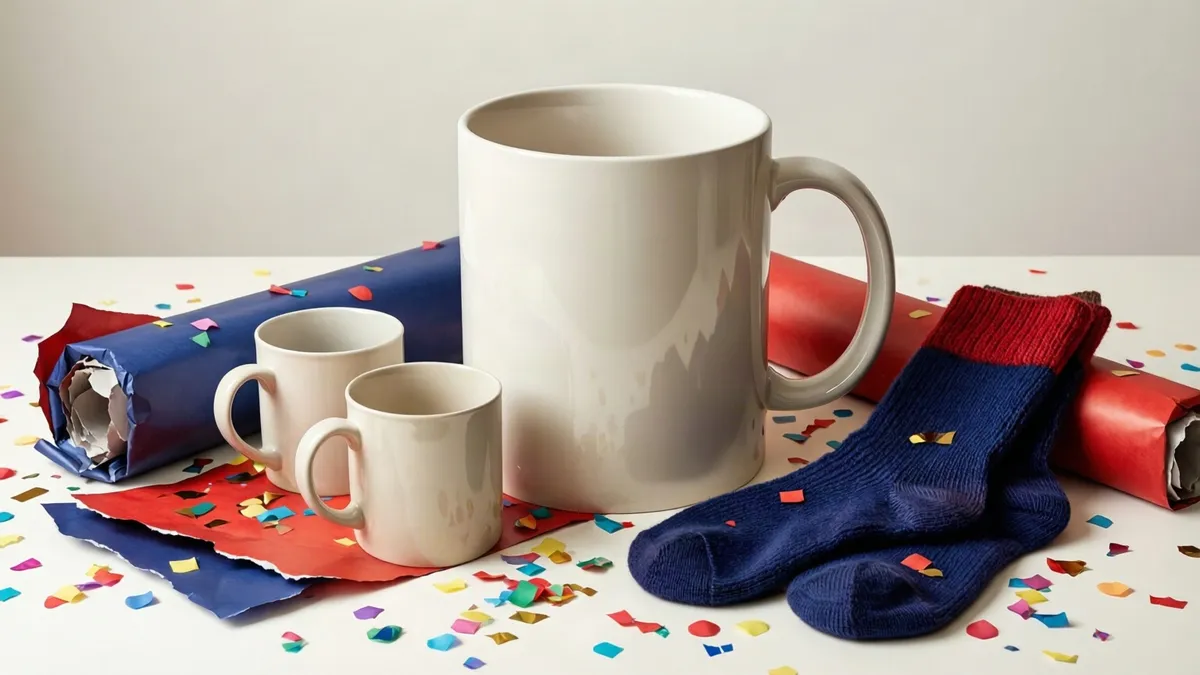
The absurdly oversized mug. Scale is the joke and the joke never needs explaining. It also holds coffee, goes in a dishwasher, and occupies the same cupboard slot as a normal mug. Check the listing for the stated capacity and whether it is microwave-safe before you buy. Browse oversized mugs on Amazon.
Calendars with a running premise. The best structural property in the whole category: it expires on schedule. Twelve installments, then it has a stated end date. No object outlives its own premise. Storage cost, effectively zero. See funny wall calendars on Amazon.
Loud socks work for a reason people rarely name. The wearer controls the audience, because the joke spends most of its life inside a shoe. That makes them one of the few gag items whose display stays entirely under the owner's control. There are novelty socks on Amazon at every level of restraint.
An apron with a premise. Same mechanism, different room. The gag only appears when somebody is already cooking, it wipes clean, and one size fits most adults. That last part removes the sizing gamble that ruins most joke apparel. Look at funny aprons on Amazon.
Single-subject cookbooks. The premise is the comedy; the recipes are still recipes. Print has no battery, no app, and no update that breaks it. Good ones survive a move. Try funny cookbooks on Amazon.
Silicone ice trays with a shape. Freezer to dishwasher, and the joke re-runs every time somebody fills a glass. Silicone is chosen for freezer-to-dishwasher use for a reason. Browse novelty ice cube trays on Amazon.
An oversized wearable blanket. Ridiculous proportions, real function, and it folds into a closet. Machine washing is the thing to confirm in the listing, since a blanket that needs dry cleaning is a chore with a hood. See wearable blankets on Amazon.
A jigsaw puzzle with a joke on the box has an underrated afterlife. The box states the piece count and the finished size, it goes back in the box when it is done, and it can be handed on intact. That last property matters more in this game than in any other. Here are funny jigsaw puzzles on Amazon.
Kinetic desk toys driven by gravity. Pendulums, sand timers and balance sculptures run on physics, so nothing charges and nothing dies. Avoid the loose-magnet versions for reasons set out below. Look through kinetic desk toys on Amazon.
One absurdly specific kitchen gadget. This one rests on judgment alone, and we will say so plainly: we have no data on how often a single-purpose gadget actually gets used. The argument is only that its comedy comes from over-engineering, and over-engineered objects tend to be built well. Browse novelty kitchen gadgets on Amazon.
The cap is the host's number, not ours. What each band buys is settled on the pillar.
The gags that die, and where they go
Four categories are pure reveal. Prank boxes whose entire content is the moment of opening. Printed-slogan apparel with one line on it. Single-use novelties. And reference gifts that need you to have seen the same thing the buyer saw.
Once the reveal is spent, none of them has a second function to fall back on.
The data on what happens next is not gentle.
A 2017 YouGov survey asked about disliked gifts and reported that 30% of recipients "simply tossed it in the garbage." Another 42% regifted it, and 40% returned it for store credit. YouGov's page displays no sample size or field dates, so read it as directional. It is also nearly a decade old, which matters less here than it looks, because the disposal options have not changed.
The National Retail Federation published its 2025 Retail Returns Landscape on October 15,
- It projected total retail returns of $849.9 billion for the year. That is about 15.8% of sales, with an estimated 19.3% of online sales going back. The figure covers all returns rather than gift returns, and no survey anywhere measures gag gifts specifically.
Landfill is the other exit.
The U.S. Environmental Protection Agency's most recent Facts and Figures data covers 2018. It put durable goods at 57.1 million tons of municipal solid waste. Only 18.5% was recycled, and 37.4 million tons went to landfill. Textiles, the joke-sweater tier, came to 17 million tons generated, a 14.7% recycling rate, and 11.3 million tons landfilled. Neither figure isolates gifts or novelty items.
And the safe alternative is not automatically safe. Bankrate's 2024 survey was fielded by YouGov Plc among 2,373 U.S. adults, on August 19 to 21. It found 43% of Americans holding at least one unused gift card, voucher or store credit, averaging $244 per person. Reaching for a gift card to dodge the problem just moves the unused object into a wallet.
Three gags the federal code already argues with
Some perennial novelty-basket items sit inside a specific federal rule. Knowing the rule is faster than debating taste.
Cartoon-shaped lighters. Federal regulation at 16 CFR 1210.2(d) defines a "novelty lighter." The term covers one with entertaining audio or visual effects. The definition also covers a lighter resembling articles "appealing to or intended for use by children under 5 years of age."
Such a lighter must be "resistant to successful operation by at least 85 percent of the child-test panel" under 16 CFR 1210.3(a). The rule regulates the design; it does not ban the product. Still, a lighter in a pile a stranger draws from is a poor bet.
Loose-magnet desk toys. 16 CFR Part 1262 covers consumer products sold for "entertainment, jewelry (including children's jewelry), mental stimulation, stress relief" that contain loose magnets. Any magnet fitting inside the small-parts cylinder must measure "less than 50 kG² mm²" of flux index. So the magnet desk toy is the most regulated object on the novelty shelf.
Costume contact lenses. Federal statute at 21 U.S.C. § 360j(n) states that "All contact lenses shall be deemed to be devices." No carve-out exists for non-corrective or purely cosmetic ones. Because they are regulated medical devices, a prescription is required, which rules them out of a blind exchange entirely.
FAQ
What makes a funny white elephant gift actually work?
It has a second function once the laugh is spent. Ask what the object does on an ordinary Tuesday, and who stores it in the meantime. If the answer to the first is "nothing," the answer to the second becomes a problem.
Are funny gifts a bad idea for an office exchange?
Not inherently, but the room is unfamiliar by design. Bitterly, Brooks and Schweitzer's 2017 JPSP research found that inappropriate humor attempts signal low competence and damage the teller's status. Aim the joke at an object's scale or specificity and that risk mostly disappears.
What kinds of funny gifts should I skip at work?
Anything whose entire content is the reveal, anything that needs a disclaimer, and anything aimed at a category of person. Scent, politics and anything with a battery you cannot vouch for also belong on the skip list. Your employer's gift policy outranks any of this.
Do funny gifts get stolen more often than useful ones?
Nobody has measured that, and any site telling you otherwise invented the number. What is documented is the aftermath: a 2017 YouGov survey found 30% of disliked gifts went in the garbage.
How much should I spend on a funny white elephant gift?
Ask the host for the cap; there is no default. The only real overspend here is a joke with no object attached to it.
Is a gift card a safer choice?
Safer to buy, not necessarily better to receive. Bankrate's 2024 survey found 43% of Americans sitting on unused gift cards worth $244 on average. At a work exchange there are also tax wrinkles, so check your employer's policy first.
What do I do if I draw a gag gift I do not want?
Regift it deliberately or donate it while it is still boxed, which is what 42% of YouGov's 2017 respondents did with gifts they disliked. Doing it in January beats discovering it in a closet in June. Skip the trash bag if the thing is still usable.
Sources
- Waldfogel, Joel. "The Deadweight Loss of Christmas: Reply." The American Economic Review, Vol. 86, No. 5, December 1996, pp. 1306–1308. https://cool.ntu.edu.tw/files/3543588/download?download_frd=1 — retrieved August 20, 2026.
- Waldfogel, Joel. "The Deadweight Loss of Christmas: Reply." The American Economic Review, December 1996 (source of the 66–84 percent valuation figures). https://cool.ntu.edu.tw/files/3543588/download?download_frd=1 — retrieved August 20, 2026.
- Waldfogel, Joel. "The Deadweight Loss of Christmas: Reply." The American Economic Review, December 1996, characterizing Sara J. Solnick and David Hemenway, "The Deadweight Loss of Christmas: Comment," AER 86(5), 1996. https://cool.ntu.edu.tw/files/3543588/download?download_frd=1 — retrieved August 20, 2026.
- Bitterly, T. Bradford, Alison Wood Brooks and Maurice E. Schweitzer. "Risky Business: When Humor Increases and Decreases Status." Journal of Personality and Social Psychology, 112(3), 2017, pp. 431–455. https://www.hbs.edu/ris/Publication%20Files/Bitterly%20Brooks%20Schweitzer%20JPSP%202016_54efbab5-2561-4408-b008-38d958e0ad50.pdf — retrieved August 20, 2026.
- Hu, Xiaoran. "Leader humor: A double-edged sword." Current Opinion in Psychology, Vol. 54, 101698, available online September 27, 2023. https://researchonline.lse.ac.uk/id/eprint/120578/1/Hu_leader_humor_published.pdf — retrieved August 20, 2026.
- Chen, Wang and Bao. "Why does leader aggressive humor lead to bystander workplace withdrawal behavior?—Based on the dual path perspective of cognition-affection." Frontiers in Psychology, 13:925029, 2022. https://pmc.ncbi.nlm.nih.gov/articles/PMC9531020 — retrieved August 20, 2026.
- YouGov. "A third of people tossed unwanted holiday presents in the garbage." January 12, 2017. No sample size or field dates displayed on the page. https://yougov.com/en-us/articles/17378-unwanted-holiday-gifts — retrieved August 20, 2026.
- National Retail Federation. "2025 Retail Returns Landscape." October 15, 2025. Survey of 2,006 consumers and 358 ecommerce professionals, summer 2025. https://nrf.com/research/2025-retail-returns-landscape — retrieved August 20, 2026.
- U.S. Environmental Protection Agency. "Durable Goods: Product-Specific Data." Advancing Sustainable Materials Management facts and figures, data year 2018; no page-update date displayed. https://www.epa.gov/facts-and-figures-about-materials-waste-and-recycling/durable-goods-product-specific-data — retrieved August 20, 2026.
- U.S. Environmental Protection Agency. "Textiles: Material-Specific Data." Data year 2018; no page-update date displayed. https://www.epa.gov/facts-and-figures-about-materials-waste-and-recycling/textiles-material-specific-data — retrieved August 20, 2026.
- Bankrate. "Survey: 43% of Americans Have At Least One Unused Gift Card." September 23, 2024. Fielded by YouGov Plc among 2,373 U.S. adults, August 19–21, 2024. https://www.bankrate.com/credit-cards/news/gift-cards-survey/ — retrieved August 20, 2026.
- U.S. Consumer Product Safety Commission. "16 CFR §§ 1210.2(d) and 1210.3(a), Safety Standard for Cigarette Lighters." CFR 2018 edition text on GovInfo, no separate display date. https://www.govinfo.gov/content/pkg/CFR-2018-title16-vol2/xml/CFR-2018-title16-vol2-part1210.xml — retrieved August 20, 2026.
- U.S. Consumer Product Safety Commission. "16 CFR Part 1262, Safety Standard for Magnets." CFR 2024 edition text on GovInfo, no separate display date. https://www.govinfo.gov/content/pkg/CFR-2024-title16-vol2/xml/CFR-2024-title16-vol2-part1262.xml — retrieved August 20, 2026.
- United States Code. "21 U.S.C. § 360j(n), Federal Food, Drug, and Cosmetic Act." U.S. Code 2023 edition on GovInfo. https://www.govinfo.gov/content/pkg/USCODE-2023-title21/html/USCODE-2023-title21-chap9-subchapV-partA-sec360j.htm — retrieved August 20, 2026.
Written by Dana Kowalski, gift-exchange editor. More on how we work is in about and in our affiliate disclosure. Browse every gift pick or read the rest of the articles.